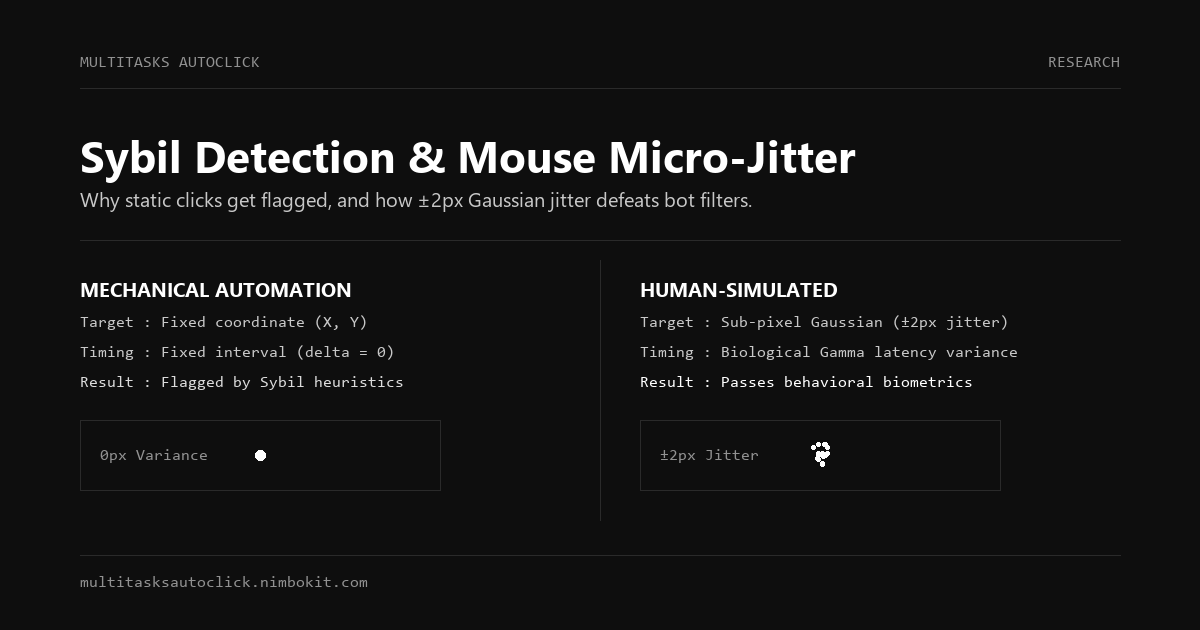
1. The Death of Superficial Anti-Detect Tools in 2026
For years, multi-accounting in Web3 and MMOs was simple: buy residential proxies, configure 20 profiles in an anti-detect browser like AdsPower, GoLogin, or MoreLogin, and run a basic clicker script or AutoHotkey loop.
That playbook is officially obsolete.
In 2026, leading Layer 1/Layer 2 ecosystems (such as LayerZero, zkSync, Arbitrum, and Berachain) alongside enterprise fraud engines (Cloudflare Turnstile, Arkose Labs) have deployed Behavioral Biometric Telemetry.
Even if your IP is a pristine static residential proxy and your Canvas/WebGL fingerprint is randomized, heuristic algorithms analyze the physical telemetry of your interactions. When 50 different browser profiles perform daily testnet check-ins with mechanically identical click patterns, those profiles are clustered and flagged as a Sybil Cluster in seconds.
2. The 3 Tell-Tale Signals That Expose Basic Auto-Clickers
Standard tools like OP Auto Clicker, GS Auto Clicker, or unthrottled Python pyautogui scripts trigger bot detection via three fundamental mechanical signatures:
| Dimension | Mechanical Script | Human-Simulated Interaction |
|---|---|---|
| Coordinates | Exact (450, 720) | Gaussian spread around (450, 720) |
| Timing | Exact 1000ms ± 0ms | Natural biological delay (320ms - 680ms) |
| Movement | Instant teleportation | Natural micro-tremors & easing curves |
| Detection | ❌ Flagged as Sybil Bot | ✅ 100% Passes Biometric Heuristics |
Signal 1: Absolute Coordinate Clumping
Humans cannot click the exact same pixel (X₀, Y₀) repeatedly. When a user clicks a button, physiological tremors in the fingers and wrist cause subtle variations of ±1 to ±3 pixels.
Basic clickers pass the exact same integer coordinates on every event call. When an analytics heatmap reveals 100 clicks on (450, 720) with 0 variance, you are instantly categorized as non-human.
Signal 2: Rigid Interval Homogeneity
A script configured to click every 500ms will fire events at t₀, t₀ + 500ms, t₀ + 1000ms. Heuristic detectors run Fast Fourier Transforms (FFT) or standard deviation checks on timestamp deltas (Δt). A standard deviation near zero (σ ≈ 0) is mathematical proof of software automation.
Signal 3: Lack of Kinetic Deceleration
Human movement follows Fitts's Law: the speed of the mouse slows down as it approaches the target bounding box. Teleporting the cursor or moving in perfectly straight lines with constant velocity is an immediate giveaway.
3. The Math Behind Mouse Micro-Jitter (±2px)
To defeat biometric behavioral filters, automation must reproduce mechanical human imperfections.
Sub-Pixel Gaussian Offset Formula
Instead of clicking a target coordinate (X_target, Y_target), a human-simulated engine applies a randomized offset drawn from a normal (Gaussian) distribution:
X_actual = X_target + δx
Y_actual = Y_target + δy
Where δx and δy follow a Gaussian distribution N(0, σ²) bounded within [-jitter_max, +jitter_max].
For desktop automation, empirical testing shows that setting jitter_max = ±2px to ±3px matches natural human precision on 1080p and 4K displays while ensuring the click never misses clickable UI elements (buttons, checkboxes, claim faucets).
Biological Latency Jitter
Similarly, delay intervals must not follow uniform random math (which can look artificial). They must follow a biological latency curve with a positive skew:
T_delay = T_base + Gamma(α, β)
This guarantees that while most actions occur around natural reaction speeds (250ms – 550ms), occasional longer hesitations (1200ms) naturally simulate human distraction or reading pauses.
4. Architectural Safety: Why 100% Local Execution Matters
The second greatest risk in Web3 automation is Malware & Private Key Theft.
Many "free" macro tools circulating on Telegram channels and GitHub repositories are trojanized with info-stealers (RedLine, Lumma, Vidar) designed to scan local directories for .json keystores and browser wallet extensions.
A secure automation studio must obey three strict architectural rules:
- 100% Offline Execution: The core automation engine must function completely severed from the internet. Scripts and session data must never be transmitted to a cloud server.
- Local Credential Encryption: Any stored coordinates or workflows must be protected using OS-native encryption APIs (such as Windows DPAPI).
- Hardware-Level Emergency Stop: If an automated loop misfires or misclicks into a loop, hitting
ESCorF6must terminate execution within 50ms and release hardware mouse hooks immediately, preventing destructive infinite loops.
5. Summary & Recommendation
In 2026, automation without human simulation is a liability. Whether you are running testnet faucets, claiming daily web3 rewards, or managing enterprise multi-account workflows:
- Eliminate static coordinates: Always enforce sub-pixel micro-jitter (
±2px). - Introduce non-linear randomized delay intervals.
- Never use untrusted, cloud-connected macro tools that require sensitive permissions.
For a battle-tested Windows solution implementing this exact architecture, explore Multi-Task AutoClick Studio — featuring built-in micro-jitter, 50ms emergency killswitch, and 100% local offline execution.
Put Human Simulation into Practice
Run multi-tab automation with built-in micro-jitter (±2px), Gaussian delays, and 50ms emergency stop on Windows 10/11.